Cyber Heroes 2.0, Baku, Azerbaijan

An international training course for youth workers entitled Cyber Heroes 2.0 took place during the week of November 22–30, 2025, in Azerbaijan's capital, Baku. Its aim was to train two dozen youth workers not only in personal cyber security, but also to provide them with the theory and experience to pass on this knowledge to the young people they work with. There was also a cultural dimension in the form of experience sharing, an excursion to the prehistoric settlement of Gobustan, and an international evening with a presentation of typical dances, customs, and dishes from the participating countries.
The international training in Baku followed on from a weeklong training course in the Czech Republic in mid-September, which I unfortunately did not attend. But the topic was different, so it didn't matter. In this second part, we focused mainly on strong passwords, safe use of technology, critical thinking, use and recognition of artificial intelligence, adaptability, secure communication, and digital footprints.

Ransomware
Ransomware is a type of computer virus that locks all data on a computer, preventing the user from accessing it. This usually happens when a program is launched via an unknown link in a fraudulent email or, for example, from an unsecured flash drive, etc. Hackers often demand a ransom to unlock the data, which is their main motivation, and it is up to the user to decide whether they can do without the data or not. After all, they can never be sure that the hacker will unlock it or that they won't demand an even higher ransom if they agree. There are two ways to help. First, don't click on suspicious or strange-looking links in emails, and second, back up your data. Then losing it won't hurt so much.
Cyberattacks in participating countries
In Italy, cybersecurity at the state level is handled by the CSN organization, and an amusing fact is that one politician thought someone had hacked his computer and it had stopped working, but it was just the battery that had run out. In Pakistan, they created the world's first virus, called Brain, in 1986. There have been several incidents, from tax payment data leaks to ID card data leaks. In Turkey, the biggest attack was a DDoS attack in 2015 that disrupted state and important websites, and a funny fact is the theft of six million marshmallows from a warehouse. In Azerbaijan, the website of the Ministry of Internal Affairs was hacked in 2012.

Digital footprint
Each of us leaves a digital footprint on the internet. Some larger, some smaller. And this can influence how others see us – not only today, but also in the future. It can encourage highly targeted cyberstalking or phishing. And in the worst cases, it can lead to unauthorized payments, identity theft, etc.
That's why it's good to have an overview of what information is commonly available about us. Try typing your name, your name and city of residence, your name and job title, your university into Google, or search for PDF files, and you'll be surprised how much you find. Finally, try giving this task to some artificial intelligence—ask it to write down as much information about you as possible (both personal and professional, as well as leisure activities).
Tools that can help:
What now? Review the privacy settings of all your services and adjust them so that they serve you, not threaten you. Communicate and ask others before sharing any content that concerns them. And delete or deactivate accounts you no longer use.
Interesting terms:
Sharenting – excessive sharing of information about one's children by parents
Parasociological relationship – a relationship based solely on a person's online presence
Kidfluencer – a child influencer

Excursion
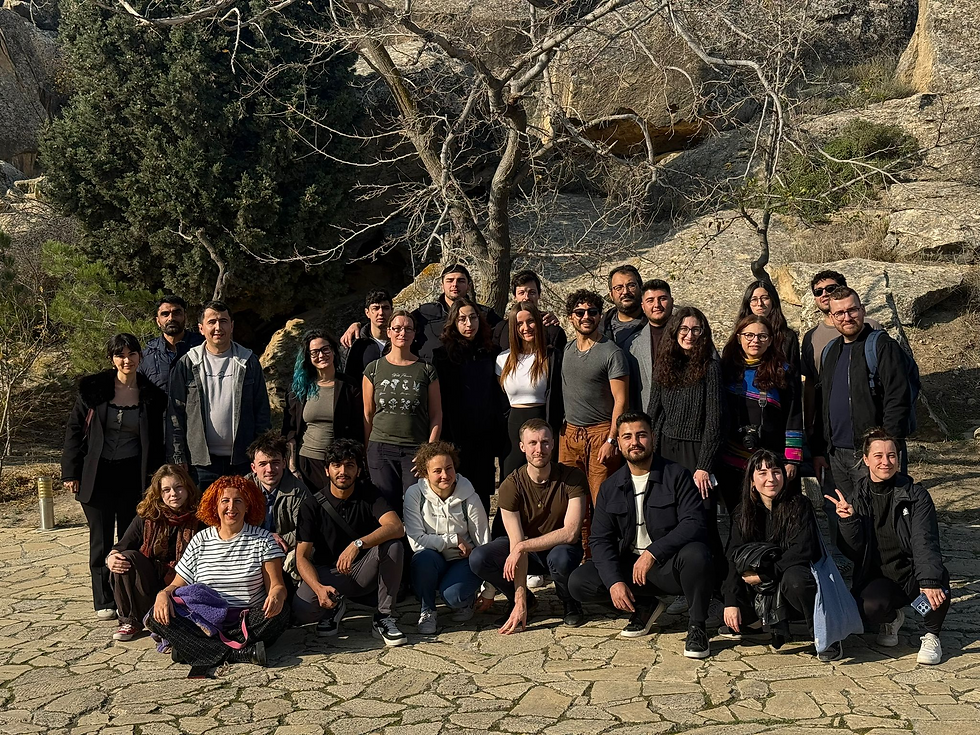
We spent a whole day exploring the prehistoric settlement of Gobustan and the nearby mud volcanoes. Dozens of engravings in the sandstone rocks depicted both life and fauna at that time. Horses, bison, bulls, and especially human figures. The museum had a surprisingly interactive presentation. The mud volcanoes were a big disappointment because, unlike their online presentation, they are a protected area, so instead of taking a healing bath, you are not even allowed to touch them.
How to prepare a workshop
When preparing a workshop, it is necessary to consider several aspects – structure, approach, tone, topics, activities, participant motivation, and materials. For older participants, it is good to have all materials in paper form, speak clearly and distinctly, and avoid special terminology. It is better to describe cases that they are familiar with and that concern them (for example, romantic scam emails or bank fraud, rather than social media). With students, it is necessary to grab their attention in the first few minutes and then think about frequently changing activities to maintain their attention. There must be constant activity. Employees will appreciate examples relevant to their work and honest data (research, pie charts, etc.). They will also appreciate specific quick guides to the necessary tools rather than lengthy theory or simulation.
Creating educational games
Seven new educational games were created during the week. A cyber version of the well-known game Monopoly or Snakes and Ladders, a cyber version of the game Mafia, cyber memory, cyber truth or dare, cyber Ludo, and an online game on cyber security.

Media manipulation
One of the great interactive games on media manipulation and news filtering is Chicken Intelligence Agency (Ch.I.A. app). In it, you can try out what it's like to be a smart chicken trying to prevent its owner from discovering that domestic chickens are intelligent.
Hoax
A hoax is unsolicited misleading information that spreads massively. That is why it is necessary to engage critical thinking and fact-checking. Sometimes, website operators just want to get clickbait, i.e., clicks on their content based on the headline. They make money from each such click. Headlines are often written to provoke emotions, arouse curiosity or even hatred, so that the reader is emotionally compelled to read more. Even if the actual content is about something else or less controversial. For example, false "news" or reports of the death of a famous person are often spread in this way.

Disinformation
Disinformation is deliberate false information that is released online with the aim of causing harm. Unlike misinformation, which is spread unknowingly, disinformation is intended to defame and cause chaos or spread falsehoods. It plays on emotions and aims to undermine trust in the government or important organizations, generate financial profit, or deliberately harm a particular entity or person. It can also give rise to conspiracy theories.
Deepfakes and the role of artificial intelligence
The online space can thus become the scene of many deepfakes or AI-generated videos that are completely false and misleading. All you need to create one is the voice-generating ElevenLabs and the video-generating tool HeyGen. Conversely, the Verifee tool can help detect creations of artificial intelligence.

Hackers
There are three types of hackers – white, black, and gray. White hackers are helpful, assisting in protecting institutions, testing their defenses, or stopping global and local threats (for example, Marcus Hatchins, who helped stop the global spread of the WannaCry ransomware in 2017). Black hackers, on the other hand, cause damage to institutions and data or for profit. They can be beginners (script kiddies), organized groups, or state-sponsored organizations (Stone Panda, Turla, Charming Kitten, Lazarus, Fancy Bear, etc.).
Cultural and international exploration
During our free time, we also had the opportunity to explore Baku and its attractions. From the Flame Towers, to the promenade along the Caspian Sea, Crescent Mall, to the Zoroastrian Fire Temple. The city is an interesting mix of modern and ancient. It is possible to find a historic building next to a building made entirely of glass in an unusual shape.
I am grateful to the non-profit organizations Fakescape and Genesis, which joined forces to make this project happen. In particular, I would like to thank the trainers Tereza, Pavel, and Stella, who passed on valuable knowledge and skills to us. I would also like to thank the Erasmus+ program for financially supporting this activity.
